
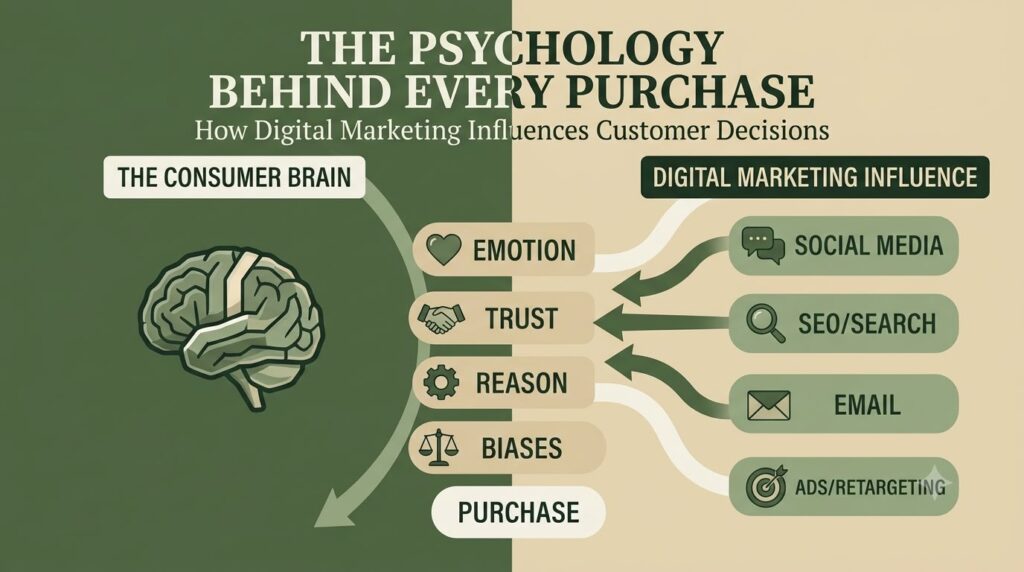
Have you ever wondered why you buy one product instead of another—even when they seem almost identical? The answer often lies not in the product itself, but in the psychology behind the buying decision. Every day, businesses use digital marketing techniques to influence how customers think, feel, and ultimately make purchasing decisions.
Modern consumers are exposed to thousands of advertisements every day. Yet only a few capture their attention. Successful marketers understand that people don’t make decisions based on logic alone—they are heavily influenced by emotions, trust, social proof, and subconscious triggers.
Understanding consumer psychology helps businesses create better marketing strategies while helping customers make informed decisions. Let’s explore the psychological principles behind successful digital marketing. The most successful digital marketing campaigns don’t simply advertise products—they understand people.
Businesses that recognize customer emotions, build trust, create valuable experiences, and communicate honestly are far more likely to succeed.
Psychology helps marketers understand why people buy, while digital marketing provides the tools to connect with customers at the right time, in the right place, and with the right message.
As technology and AI continue to reshape the digital landscape, understanding human behavior will remain one of the most valuable skills in marketing. Businesses that combine data-driven strategies with genuine empathy will build stronger customer relationships and achieve sustainable growth in the years ahead. Every purchase begins long before a customer clicks the “Buy Now” button. Behind every buying decision lies a complex mix of emotions, habits, beliefs, and psychological triggers. Whether someone is purchasing a smartphone, booking a holiday, or ordering dinner online, their decision is rarely based on logic alone.
Digital marketing is successful because it understands how people think. Rather than simply promoting products, marketers create experiences that influence attention, build trust, spark curiosity, and encourage action.
According to behavioral research, emotions play a significant role in decision-making, while logic is often used afterward to justify the choice. This is why the world’s most successful brands invest heavily in storytelling, branding, customer experience, and personalization instead of focusing only on product features.
Understanding these psychological principles helps businesses market more effectively while helping consumers recognize the factors influencing their choices.